since my last confession. Today the boat escaped the basement at long last. I had to make room for HVAC workers and new HVAC parts. Until today, one thing has led to another, and the rowing project has been sidelined over and over.
June 12, 2026. I am amazed: freed from its claustrophobic shipyard, the boat is beautiful!
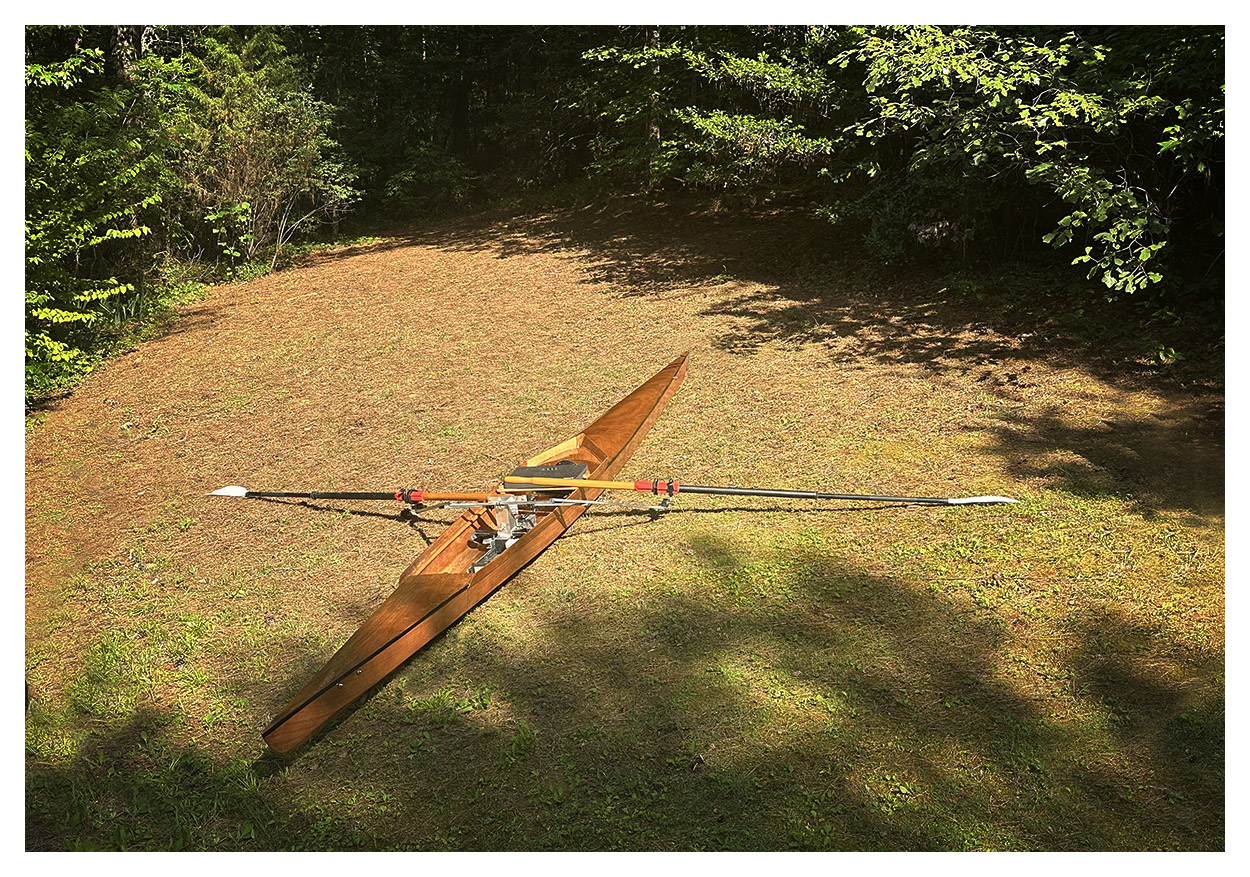
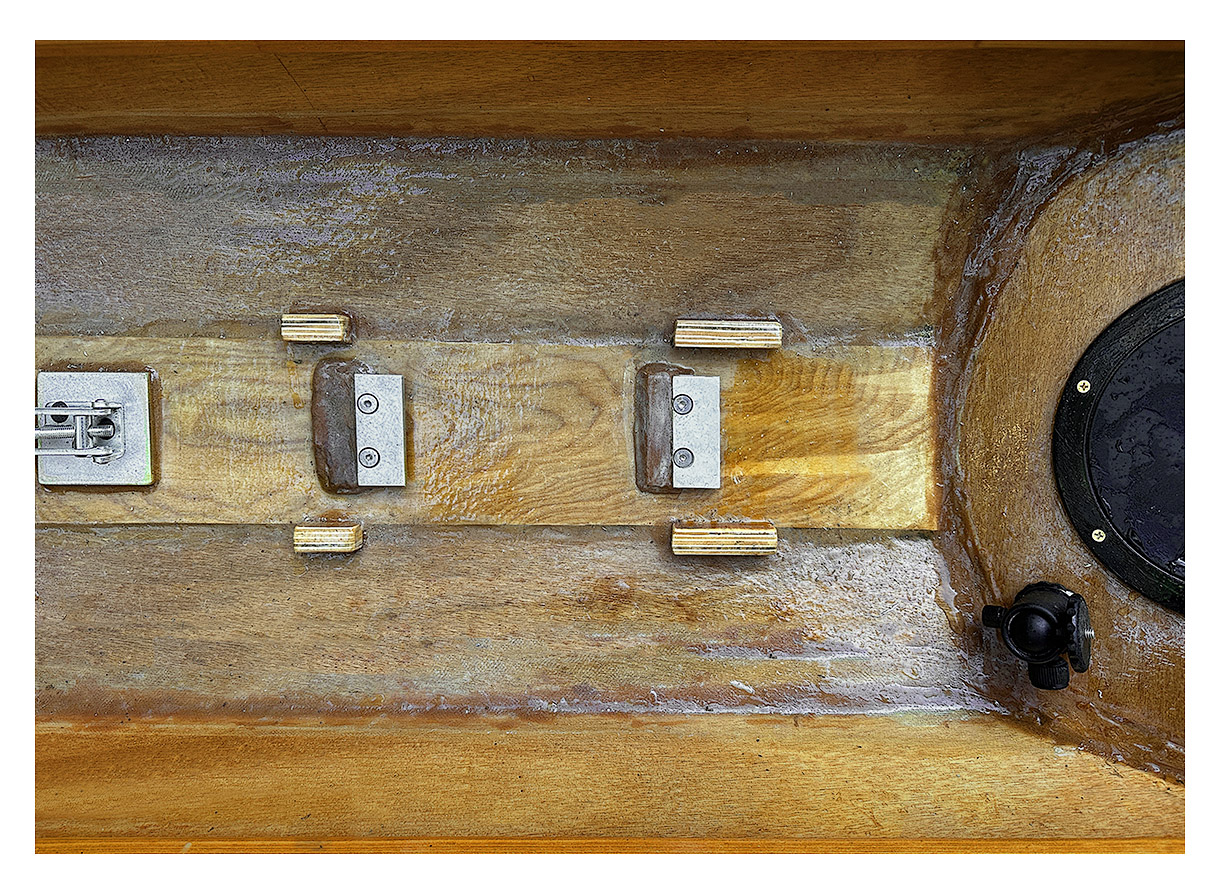
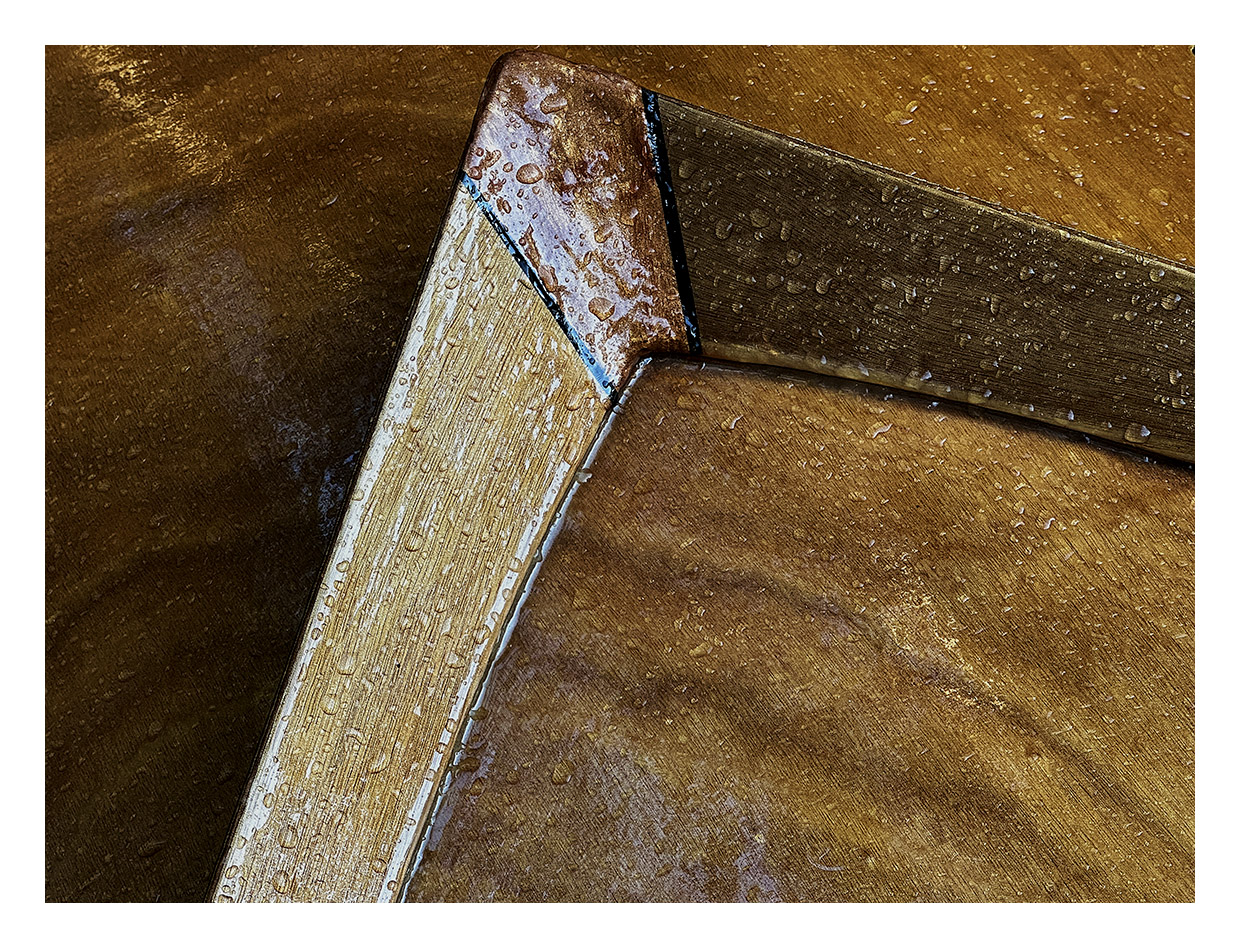
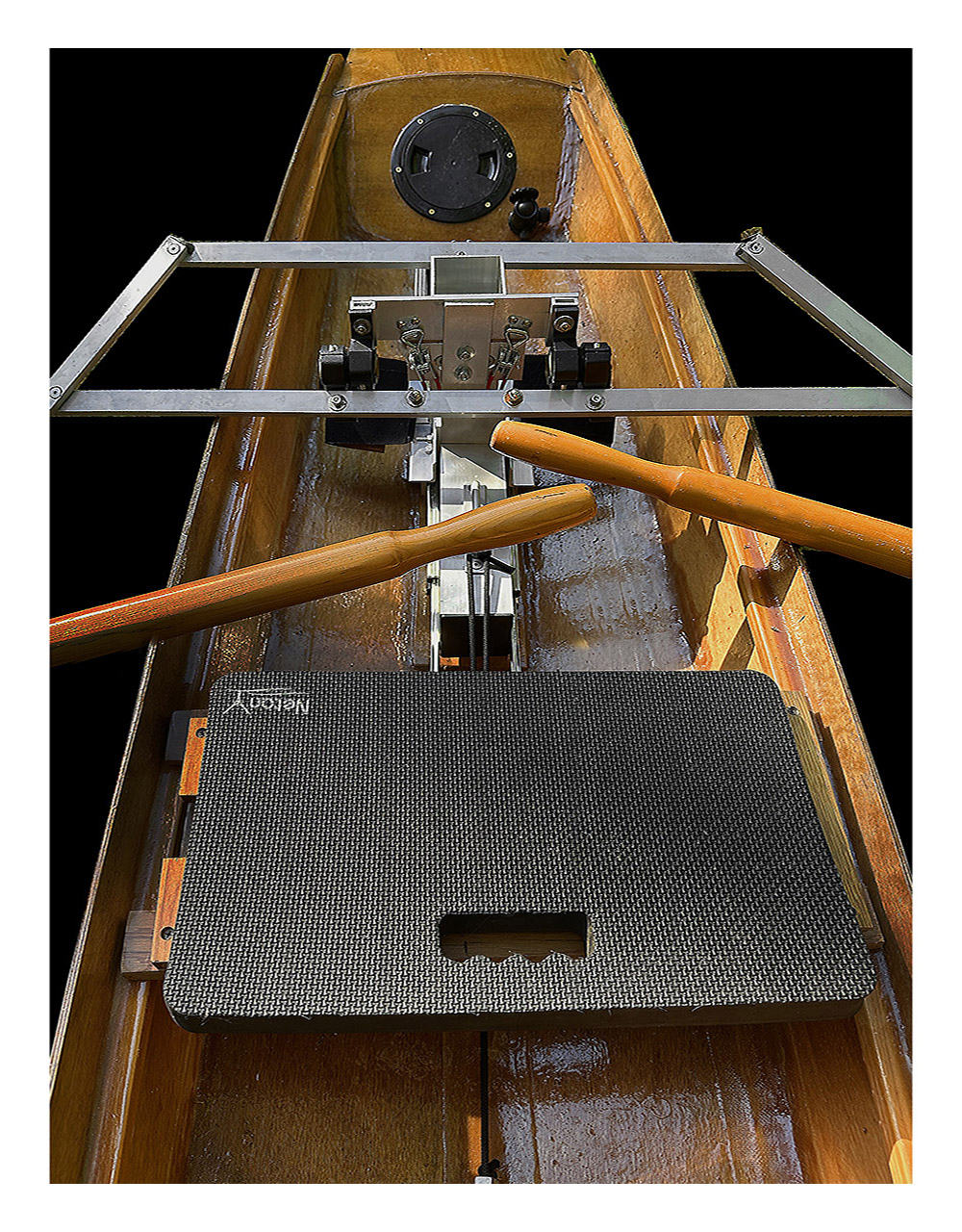
Moving it around on a cart designed for much smaller craft was a pain further complicated by the need to protect the skeg. I put larger wheels on the cart for generous ground clearance. The boat likes to twist relative to the axle which leads the whole kit astray. I got well along in making longer rails to hold everything more firmly in general and at right angles to the axle before discovering that my once-thought-to-be-infinite supply of 1/4×20 bolts is exhausted. The 8 two-inch ones I need for this sub-project will arrive in a couple of days.
June 15, 2026. Fixed. I clamped some right-angle aluminum stock to the top of the canoe carrier using 1/4×20 bolts, nuts, and 3/4-inch-wide flat aluminum stock. I taped 2-inch aluminum tubes to the angle stock to serve as support rails. I’ll need something compressible to both protect and grip the hull before using this for real (split noodles work for now). A rubber strap holds cart and hull together. Leave the rigger in place while wheeling the boat to the water’s edge and carry the oars. It’s coming along.
June 19, 2026. I’d like to say I left the boat out in the rain (0.4 inches over a day and a night) as a test, but the truth is that I got busy and couldn’t find a tarp quite large enough to completely cover the stateroom. I bailed out the collected water and then found more. Rinse and repeat. I elevated the bow and opened the front hatch and found more water. The front bulkhead is evidently not as watertight as expected. Epoxy and fiberglass and varnish are not enough? There must be a gap (or gaps) somewhere. Unintentional tests are often the most effective since they don’t come with built-in assumptions. In the meantime, the Space Blanket I’ve been using as a cover is just that little bit too small. A couple of tarps just that little bit larger are on the way (and are here in record time; very lightweight but well-sized).
The rigger was grinding lightly against something which turned out to be part of the clamp that applies tension when the drop-in rigger is in place. An upright bar is forged into its base with a hole through which a lock can be threaded. The upright was just a little too tall. I filed a few mm off the top, and all is smooth again. I don’t expect to ever need to put a lock there, but I still could if I ever do. The three bolts that attach the clamp assembly to the deck are already rusted (unlike any others anywhere). I tested one to be sure it can be removed and then sprayed WD-40 all over the contact surfaces. I’ll replace all three bolts with stainless steel right soon. I tell myself I am not procrastinating — I am collecting small issues to be dealt with together.
It’s as if the boat, removed from the table that has supported it all these years, is relaxing, shifting, adjusting slightly, and some of the original tolerances are not entirely adequate for these new stresses and strains. I’ll deal.
A few last minute thoughts.
This lake is not entirely empty, especially in summer. How about rear view mirrors? Three possibilities come to mind. (1) versions that clamp onto sunglasses (see bicycling days), or (2) dedicated visors (TriEye) that are ideal but expensive especially in glare-suppressing versions, or (3) handlebar-mounted bicycling mirrors (my seat does not move, so maybe these could be used). [Amazon Prime days offered discounts on the TriEyes but not deep enough to make them irresistable. Instead, I bought a set of bicycle handlebar-mount mirrors with the idea that I’ll make quick-release fittings to clamp them to the coaming near my seat. I have an unusual boat with a fixed seat and a moving rigger, and I have a lathe — let’s see what advantages I can find.] Then TriEye discontinued the glasses I wanted and offered a discount on their remaining stock. Bluff called. <sigh>
Think about rollers to help get it onto the car carrier. I have ideas. Of course I do. Watch me over-design this. I bought a cheap canoe/kayak roller off eBay. Maybe it’s a complete solution, else its shortcomings will expose my needs. It’s a start. [6/27: that roller is a surprisingly solid piece of kit, so much so that I bought a second one in a different configuration — used alone or in tandem, I think they’ll solve the puzzle of how to load the boat onto a car carrier.]
To stop or limit the rigger’s motion to simplify early rowing efforts, I need only drop a short pool noodle (or similar) into the tracks to block its motion. It took me long enough to think of that, didn’t it?
One of the take-apart sculls developed some play at the splice between cheap oar and cheap kayak paddle (not at the spring-loaded take-apart joint, which is fine). I slathered J. B. Weld over the surfaces involved, put them back together, and let everything cure overnight. It might be okay, but I thought some sort of external sleeve couldn’t hurt. I wrapped the joint and adjacent areas with 1.6mm, 3-strand jute rope wetted out a couple of times with leftover Total Boat FlexEpox (geez, that stuff’s gotten expensive! if I hadn’t had a couple of partial bottles sitting here, I’d have found an alternative). Mine was a messy, inelegant, and clumsy job, but I am sure that using boiling pitch on heftier ropes on a rolling sea has been done less neatly more than once. A moderate bit of sanding and a second coat smoothed it all out nicely. Even less sanding and a coat of Interlux Spar Varnish “Original” for completeness and, technically, for UV protection followed. The varnish was old and thick, and though I stirred vigorously, it’s been reluctant to dry. 30 hours on, it’s better but not really good. Old? Inadequate stirring? Too heavy a coat?
To deal with the sticky varnish, I tucked part of the scull into the “proving oven” — the utility space under our asphalt roof where the temperature tops out at well over 110F on sunny summer days. After three of those, it was almost dry, but I applied something I learned way back on blog day 79: light sanding on stubborn sticky epoxy will remove the surface layer and either expose a hardened layer or allow a fresh exposure to harden. As with epoxy so with varnish? Seems to have worked like a charm. Incidentally, to search a blog for some word or phrase: https://oldmantakesuprowing.com/?s=sticky
Nagging but low-priority concerns include the small kayak-style blades on my sculls. Replacement blades can be ordered from Durham Boat Company in New Hampshire. They have a decent selection at affordable prices and very reasonable shipping. A wider assortment is available from Zijie Sport in China with the usual caveats (shipping, tariffs…). In any case, I’d need to make fittings to adapt the new blades’ presumably 38-40mm sleeves to these decidedly nonstandard sculls. I built the whole damn boat, so I am pretty sure I can handle that when the day comes.
I bought short pants to go wading and rowing, ordered some short-sleeve tees to get wet and sunscreen recommended for the sport. I’ve adjusted the sleeves and oarstops to put the blades where (I think) they belong, oriented as (I think) they belong, but not yet locked down for the ages (because I am not sure where they belong). I am paranoid about using the oarlocks backward — the pin goes toward the bow.
Stop. Please put the actual boat on actual water before taking on any additional concerns, improvements, or mods.
But first just a few more bits: a floating retainer strap for the TriEye glasses; water shoes because I am not wading in this lake without protecting my feet; a water-tight pouch for my iPhone (so if all goes well it can take GPS data and if all does not it will let me to call for help while cast up on some foreign shore); official vinyl hull-tape (widely recommended 3M-471 from an eBay seller, not Amazon) to replace the low-rent, easily messed up, electrical tape I foolishly imagined would suffice, and super-absorbent “bilge sponges” to keep the interior dry (I measured 2.5 cups of water per squeeze). While maneuvering the boat around in the yard on its modified kayak carrier, I inadvertently determined that the knock-off skeg does indeed knock off rather than damage the hull — I’ve put it back on using polyurethane adhesive and sealant so it is a not-quite-so-easy-to-knock-off skeg. I also traced the part and measured its thickness (0.090 inches) should I need to remanufacture one. And NOW maybe this old man can take up rowing.
8/16/2026. What would you think of using an ebike to tow it to the neighborhood docks, up and down our steep driveway, and up and down that damn hill? Burchda HC26 or similar? I would think I should launch the damn boat first. Dog emergencies, insane summer heat, and the need to reregister the Honda have gotten in the way. Soon!